
Signs You Need Dryer Vent Cleaning in Nashville — and Why the Obvious Ones Miss the Real Danger
Most homeowners in Nashville know the textbook warnings: clothes take forever to dry, the laundry room feels like a sauna, or there’s a faint burning smell mid-cycle. But the most dangerous dryer vent obstructions in this city don’t trigger any of those alarms until it’s nearly too late. In the three-story townhomes that dominate The Nations, Germantown, and 12 South, partial lint compaction at 90-degree elbow transitions can restrict airflow by 40–60% while still letting your dryer finish a normal cycle — and the hand-check test at the exterior vent won’t catch it. If you’re seeing any warning signs, or if you live in a tall-and-skinny with a vertical vent run, call our Best Dryer Vent Cleaning in Nashville, TN team at (844) 839-1347 for a free airflow assessment.

The Standard Signs Still Matter — Don’t Ignore Them
We don’t throw out the basics. These symptoms mean your vent needs immediate attention, full stop:
- Drying cycles that suddenly take 50% longer — a load that finished in 45 minutes now pushing past 70
- The exterior vent flap barely lifts or doesn’t open at all during operation
- Clothes come out hotter than they used to, especially at cycle’s end
- A burning or musty odor that shows up 10–15 minutes into drying
- Visible lint accumulation around the interior dryer connection or exterior termination
- The laundry room itself heats up noticeably during operation
These are legitimate, serious warnings. The U.S. Fire Administration reports that failure to clean dryer vents is the leading cause of residential dryer fires. But here’s what frustrates us after 17 years in this trade: by the time most Nashville homeowners notice these symptoms, the blockage has been building for months. And in certain housing types common to this city, the blockage can be severe without producing any of these telltales.
The Nashville-Specific Danger: Tall-and-Skinny Townhomes with Vertical Vent Runs
The hardest dryer vent obstruction to catch in Nashville isn’t the one that makes your clothes come out damp. It’s the partial lint dam at the second-floor elbow in a townhome chase that lets enough airflow through to seem fine — until it doesn’t.
Since roughly 2012, developers have packed Nashville’s gentrifying neighborhoods with three-story “tall-and-skinny” spec townhomes. The Nations, Germantown, East Nashville, 12 South — these areas are full of them. The dryer vent runs straight up through a narrow chase, hitting 90-degree elbows at each floor transition before terminating through the roof or a high side wall. Standard rigid cleaning rods bind at the first elbow. A shop vac with a 10-foot hose won’t reach the second. And the partial blockage that forms at these transitions? It doesn’t behave like the straight, horizontal vent runs most diagnostic guides assume.
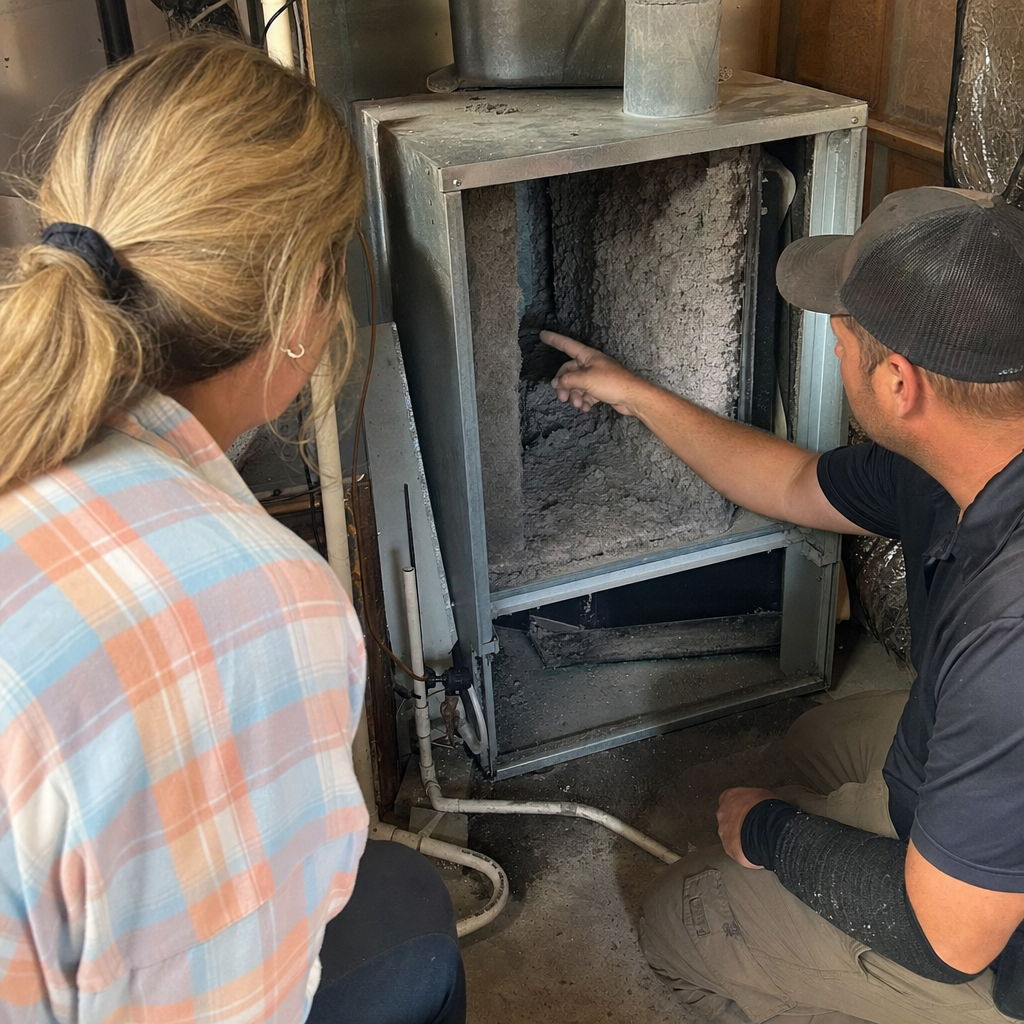
Here’s the mechanical reality that changes everything: a vent that’s 60% blocked still exhausts enough air to dry clothes in a reasonable time. The dryer compensates by running the heating element longer and hotter. Your cycle time might increase by only 8–12 minutes — easy to blame on a heavy load or humid day. But the lint trapped at that elbow is already operating at elevated temperature, and the restriction is accelerating compaction with every cycle. We’ve pulled out lint masses in 12 South townhomes that reduced the effective duct diameter from four inches to less than one and a half — and the homeowner’s only “symptom” was a vague sense that “the dryer might be a little slower lately.”
David Martinez, our owner and lead technician, measures airflow at the exterior termination with a calibrated anemometer — not a hand check. A 3-story townhome vent that “feels like air is coming out” can still be 50% restricted. The hand test is not a pass/fail. We’ve had customers tell us they checked, felt airflow, and crossed vent cleaning off their list for another year. That’s a mistake we see repeatedly in Nashville’s vertical-vent housing stock.
The Ranch-Home Blind Spot: Corroded Original Ductwork in Antioch and Hermitage
On the other end of Nashville’s housing spectrum, the 1950s–1970s ranch homes concentrated in Antioch, Hermitage, Donelson, and Madison present a different hidden failure mode. These houses often retain original metal dryer duct runs that have corroded, partially disconnected, or developed holes inside walls or crawlspaces.
The dryer appears to function normally because air is still moving — it’s just not all moving through the vent to the exterior. Lint exhausts into wall cavities, floor joist bays, or the crawlspace itself. There’s no obvious symptom. The exterior vent still shows airflow. The clothes dry. But you’re pumping combustible lint into the structure, often in proximity to electrical wiring or gas lines, while the actual vent path deteriorates further.
We’ve found disconnected vents in Hermitage crawlspaces that had been dumping lint for years. The homeowner had no idea until we ran our camera and showed them the gap. In Antioch, we see original flexible transition ducts that have sagged and formed low points where lint collects — again, no warning sign until the low point becomes a complete blockage or the sagging duct traps moisture and accelerates corrosion.
Nashville’s Humidity Multiplier: Why Partial Blockages Get Worse, Faster
Here’s a climate factor most generic dryer vent guides don’t address: Nashville’s sustained summer humidity routinely pushes 70% relative humidity with temperatures in the 90s from June through September. That humidity doesn’t stay outside. Your dryer is pulling in conditioned air, but the vent itself — especially if partially restricted — becomes a condensation zone.
Lint is hygroscopic. It absorbs moisture from humid air moving through a warm duct. Wet lint compresses more densely than dry lint. The partial blockage that was borderline in April can be critically compacted by August. We’ve documented this repeatedly: the same vent configuration in Nashville’s basin climate shows faster compaction rates than equivalent systems we service in drier markets. The geographic basin that defines our topography — ringed by cedar and hardwood forests — traps airborne particulates at ground level, and that pollen load combines with humidity to create a particularly stubborn lint matrix.
This isn’t theoretical. In Donelson, where David grew up not far from the old Opryland grounds, we regularly see spring pollen loads in dryer vents that would be unusual in neighboring cities. The vent that was “probably fine” after last fall’s cleaning can be significantly restricted before summer’s end.
What We Check — and What the Equipment Reveals
When we evaluate a dryer vent in Nashville, we don’t guess. Our process is built on 17 years of focused duct and vent work, and it varies based on what your housing type demands:
- Calibrated airflow measurement at the exterior termination, compared against the dryer’s rated exhaust capacity
- Video inspection of the full vent run when accessible, especially at elbow transitions in vertical chases
- Lint mass extraction using professional-grade Nikro negative-air systems and Rotobrush contact-cleaning equipment — not shop-vac shortcuts
- Duct integrity verification to identify separations, corrosion, or improper materials in the full run
- Exterior termination repair or replacement when the flap mechanism has failed or the hood design promotes back-pressure
The tall-and-skinny townhomes require specialized equipment. Standard rigid rods won’t navigate three stories of 90-degree transitions. We’ve invested in flexible rotary systems that can maintain contact pressure through multiple offsets — the same approach we use for complex residential ductwork. A technician who trained on ranch-style layouts in Antioch or Hermitage and shows up with basic rods is underprepared for a Germantown vertical chase. We’ve been called in after other cleaners couldn’t complete the job.
From duct cleaning to duct repair to air quality sanitizing — handled start to finish. When the owner is the technician, accountability isn’t a policy — it’s personal.
When “Normal” Dryer Operation Is Actually a Warning Sign
We want to be direct about something that contradicts most consumer advice: in certain Nashville housing types, normal operation is the most dangerous sign of all.
If you live in a three-story townhome built since 2012 — The Nations, Germantown, East Nashville, 12 South — and you’ve never had your dryer vent professionally inspected with calibrated airflow measurement, you don’t know if your vent is clear. The absence of symptoms is not evidence of clear passage. The vertical run with multiple elbows masks restriction in ways that horizontal vents cannot.
Similarly, if you live in a 1960s–1970s ranch in Antioch, Hermitage, Donelson, or Madison and your dryer vent hasn’t been inspected since you bought the home, the “normal” airflow you’re feeling at the exterior could include significant leakage into wall or floor cavities. Original metal ductwork in these homes is now 50–70 years old. Corrosion and separation are not edge cases — they’re expected maintenance issues at this age.
Our recommendation for these housing types: don’t wait for symptoms. Schedule a baseline inspection. We provide free estimates, and the airflow measurement takes less than 10 minutes. You’ll know exactly where you stand.
What Professional Dryer Vent Cleaning Costs in Nashville
Wondering How Much Does Dryer Vent Cleaning Cost? (2026 Price Guide) — Nashville, TN Pricing depends on vent configuration, accessibility, and what we find. Here’s what Nashville homeowners typically invest:
| Service | Typical Range |
|---|---|
| Standard single-story dryer vent cleaning (straight run, accessible) | $120 – $180 |
| Multi-story or vertical vent run with multiple elbows | $180 – $280 |
| Vent repair or partial replacement (corroded/disconnected sections) | $150 – $350 |
| Exterior termination replacement (damaged flap or hood) | $75 – $150 |
| Full inspection with calibrated airflow measurement | Included with service |
We don’t quote over the phone for complex vertical runs without seeing the configuration — anyone who does is guessing. What we can promise: upfront pricing once we’ve assessed your specific vent, no upsell for treatments you don’t need, and the most experienced technician on the job, not a rotating subcontractor. Call (844) 839-1347 to schedule a free estimate.
FAQs
In Nashville’s tall-and-skinny townhomes with vertical vent runs, a vent can be 50–60% restricted and still dry clothes in a nearly normal cycle because the dryer compensates with longer, hotter operation. The only reliable check is a calibrated airflow measurement at the exterior termination — a hand test won’t catch partial restriction at upper-floor elbows. If you live in The Nations, Germantown, East Nashville, or 12 South in a home built since 2012, we recommend professional inspection even without symptoms. Call (844) 839-1347 for a free airflow assessment.
DIY cleaning with a brush kit from a hardware store runs $20–$40, but it’s only effective for short, straight, accessible vent runs — and it can pack lint tighter at elbows or damage flexible ducting if used improperly. For Nashville’s common vertical townhome chases or aging ranch-home metal ductwork, DIY tools often can’t reach the blockage or identify corrosion and disconnection. Affordable Dryer Vent Cleaning in Nashville, TN with proper equipment (we use Nikro and Rotobrush systems) typically runs $120–$280 and includes inspection, measurement, and verification that the full run is clear and intact. Call (844) 839-1347 for an exact quote — estimates are free.
For standard horizontal vents in typical conditions, annual inspection with cleaning every 1–2 years is the general guideline. But Nashville’s high humidity accelerates lint compaction, and our heavy pollen loads add particulate mass that builds faster than in drier climates. For vertical townhome vents with multiple elbows, we recommend annual cleaning — the restriction at transitions compounds quickly. For original metal ductwork in 1960s–1970s ranch homes, annual inspection is prudent given corrosion risk. After 17 years serving Nashville, we’ve found that “every two years” is too long for many local configurations. Call (844) 839-1347 and we’ll assess your specific vent run and usage patterns.
We typically schedule within 24–48 hours for standard requests, and we reserve limited same-day slots for situations with active warning signs — burning smells, visible smoke, or complete airflow blockage. For tall-and-skinny townhomes with vertical runs, we may need to confirm we have the right rotary equipment available for your specific chase configuration. David Martinez, our owner and lead technician, handles every job personally, so scheduling depends on his availability — we don’t overbook and send subcontractors. For urgent concerns or to check next availability, call (844) 839-1347.
When to Call Horizon Air Duct Cleaning Nashville
If you’re experiencing any standard warning signs — extended dry times, weak exterior airflow, burning odors — your vent needs Dryer Vent Cleaning services now. But if you’re in a tall-and-skinny townhome with a vertical run, or a ranch-era home with original ductwork, the absence of symptoms doesn’t mean you’re in the clear. The most dangerous obstructions we’ve found in Nashville were in vents that “seemed fine.”
We don’t use scare tactics. We show you what we find — before and after — with camera documentation and calibrated airflow readings. Professional-grade Rotobrush and Nikro systems, not shop-vac shortcuts. 17 years. One specialty. Clean air.
Clean ducts aren’t glamorous. Neither is good plumbing. Both matter.
If you’d rather have it looked at, Horizon Air Duct Cleaning Nashville offers a no-pressure assessment in Nashville — call (844) 839-1347 for a free estimate.
Written by David Martinez, Owner & Lead Technician at Horizon Air Duct Cleaning Nashville, serving Nashville, TN.