
Nikro Air Duct Cleaning in Nashville: A Homeowner’s Guide
Nikro air duct cleaning in Nashville typically involves professional-grade negative-air vacuum systems combined with mechanical agitation to remove built-up debris from your entire HVAC duct network. When configured correctly for your home’s specific layout, a Nikro system can achieve containment levels that prevent recontamination of your living space during cleaning. If you’re evaluating providers and want to know what this equipment should actually deliver, call us at (844) 839-1347 — we’ll walk you through what proper setup looks like for your system.
Here’s the thing about Nikro equipment: it’s used by some of the best duct cleaners in the country and some of the worst. Owning a $15,000 negative-air machine and knowing how to configure it for a 2,400-square-foot Nashville ranch with a two-zone Carrier system are completely different skills. We’ve been called in after “cleanings” where the previous company ran a Nikro vacuum for two hours but never achieved actual containment — the homeowner’s furniture was dustier afterward than before. In Nashville’s climate, where humidity swings from 70% in July to dry winter heating seasons, that kind of sloppy work doesn’t just waste money; it can redistribute mold spores and construction debris through your entire house.
What Makes Nikro Equipment Technically Different
Nikro Industries builds negative-air machines and portable vacuums designed specifically for contamination control — not general shop use. The key distinction for homeowners is the combination of high static pressure and HEPA filtration that maintains containment while agitation dislodges debris.
Here’s what that means in practical terms:
- Negative pressure maintenance: A properly sized Nikro unit creates suction strong enough that air flows into the ductwork during cleaning, not out of it. This prevents the “dust storm” effect you get with inadequate vacuum power.
- HEPA filtration at the machine: Captures particles down to 0.3 microns. In Nashville, where pollen counts regularly exceed 8,000 grains per cubic meter during oak and ragweed seasons, this matters for allergy-sensitive households.
- Agitation compatibility: Nikro systems are designed to work with mechanical brushes and compressed-air whips that physically knock debris loose — not just suck at whatever’s already loose.
The equipment doesn’t clean by itself. We’ve seen crews in Belle Meade and Green Hills show up with a Nikro HP20, hook it to one return, and call it done in 45 minutes. That’s not a cleaning — that’s a vacuum rental with a logo on the side. The machine’s capability is only realized when a technician understands how to sequence access points, balance suction across zone dampers, and verify containment before agitation begins.
How Negative Pressure Setup Differs by Nashville Home Type
Nashville’s housing stock spans 1940s bungalows in East Nashville to new construction in The Nations and sprawling Williamson County builds. Each configuration demands different negative-pressure strategy.
Single-story slab homes (common in Donelson, Hermitage, Antioch):
These typically have simpler duct layouts with a single return and supply trunk. The Nikro unit can usually achieve adequate negative pressure through one or two access points. However, slab construction often means flexible ductboard or early-generation flex duct that’s fragile — excessive suction can collapse runs if the technician doesn’t throttle appropriately. We’ve learned to start at reduced RPM and verify each branch is drawing before increasing power.
Two-story builds with multiple returns (common in newer Franklin, Mount Juliet, and Nolensville construction):
These require zone isolation. A Nikro HP20 or larger negative-air unit gets connected to the main return, but the technician must seal secondary returns temporarily to prevent suction loss. Two-zone systems with variable-speed blowners add complexity — if the ECM motor is still energized during cleaning, it can fight the negative pressure or damage itself. We always verify power isolation at the disconnect, not just the thermostat.
Historic homes with retrofitted HVAC (Germantown, Salemtown, parts of Sylvan Park):
These often have mixed duct materials — galvanized steel from a 1980s retrofit, plus newer flex additions. The Nikro’s suction must be modulated to avoid damaging old tape joints or pulling flexible connections loose. In these homes, we typically use lower vacuum CFM with longer agitation cycles rather than brute-force suction.
The Verification Step Most Companies Skip
This is where we separate careful operators from marketing props. Before any agitation begins — before a single brush turns — a competent technician verifies that containment is actually working.
Here’s our sequence on every Nashville job:
- Smoke pencil test at all supply registers: With the Nikro running and the system sealed, we hold a smoke pencil at each register. If smoke draws inward, containment is working. If it drifts outward or sits stagnant, we’ve got a leak — usually a poorly sealed access panel or a bypass duct we didn’t know about.
- Pressure differential check: We measure negative pressure at the farthest supply register from the vacuum connection. Minimum 0.02 inches water column, or we’re not cleaning that branch effectively.
- Visual pre-inspection with borescope: Before agitation, we document contamination levels with a camera. This isn’t for show — it’s how we prove results afterward. Homeowners in Nashville’s 12 South and Wedgewood-Houston neighborhoods have gotten savvy about asking for this.
We pulled one out of a garage over in Inglewood last month where the previous company’s “Nikro cleaning” had actually blown a decade of dryer lint into the return duct because they never verified their connection seal. The homeowner’s laundry room was coated in fine gray dust. When the owner is the technician, accountability isn’t a policy — it’s personal. David Martinez handled that remediation himself.
How to Tell If a Company Is Leveraging Nikro or Just Name-Dropping
Anybody can rent or buy the equipment. Here’s how to evaluate whether they’re actually using it competently:
- Ask about their specific model and CFM rating. A Nikro HP20 pulls 2,000 CFM — adequate for most residential systems. If they can’t name the model or describe why it’s sized for your home, they’re treating it as a prop.
- Request the verification sequence. If they don’t know what a smoke pencil test is, or if they look confused when you mention measuring pressure at distant registers, they’re not verifying containment.
- Ask how they handle zone dampers in multi-return systems. A knowledgeable technician will explain temporary sealing or damper locking — not just “we hook it up and turn it on.”
- Demand pre- and post-cleaning documentation. We provide borescope images from before and after. If they can’t show you what your ducts looked like, they can’t prove they changed anything.
In Nashville’s competitive market, we’ve seen everything from carpet cleaners with a Nikro attachment to legitimate specialists. The difference isn’t the logo on the truck — it’s whether the person running the machine understands your specific system.
What Verifiable Results Look Like After a Proper Nikro Cleaning
After a correctly executed Nikro-based cleaning, you should be able to confirm several tangible outcomes:
Visual verification: Borescope images showing clean duct surfaces, not just “less dirty.” We show homeowners the before/after on a tablet before we pack up.
Airflow measurement: Static pressure across the evaporator coil should drop if it was elevated by debris. We measure this with a digital manometer — in Nashville’s older homes, we’ve seen reductions from 0.5″ WC to 0.3″ WC, which translates to better airflow and lower energy bills.
Particle count reduction: For allergy-sensitive clients, we can arrange third-party air sampling before and after. In our experience, properly executed cleanings reduce airborne particulate in the 0.3-10 micron range by 60-80% within 48 hours — but only if containment was maintained throughout. A sloppy job can temporarily increase counts.
No residual debris: Your home shouldn’t need additional dusting after we leave. If the negative pressure was working, everything we dislodged went into the Nikro’s HEPA filtration, not your living room.
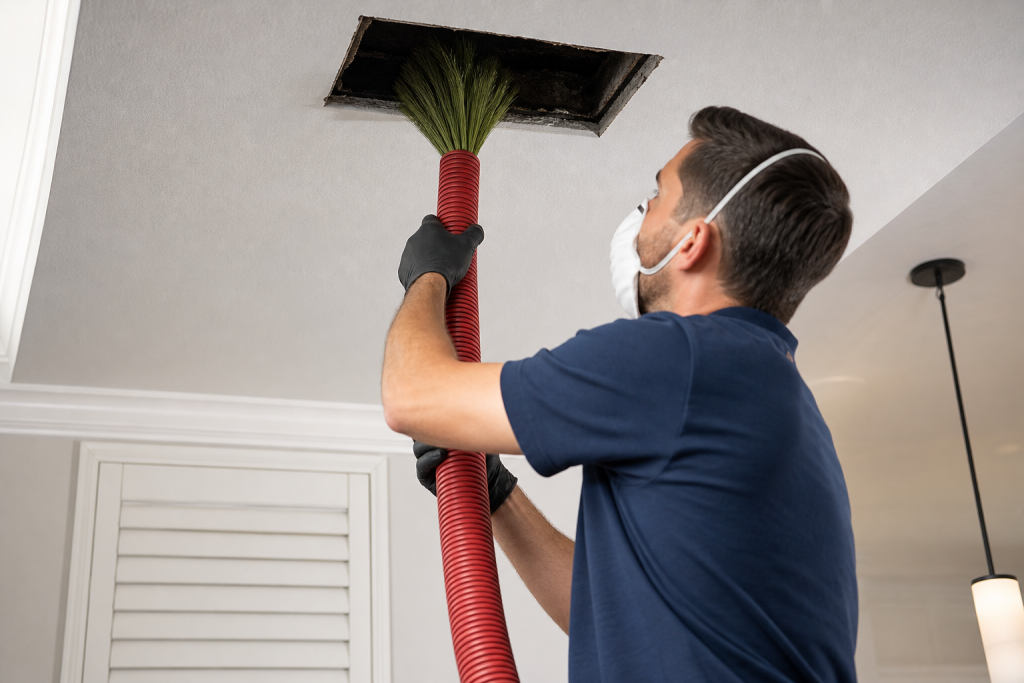
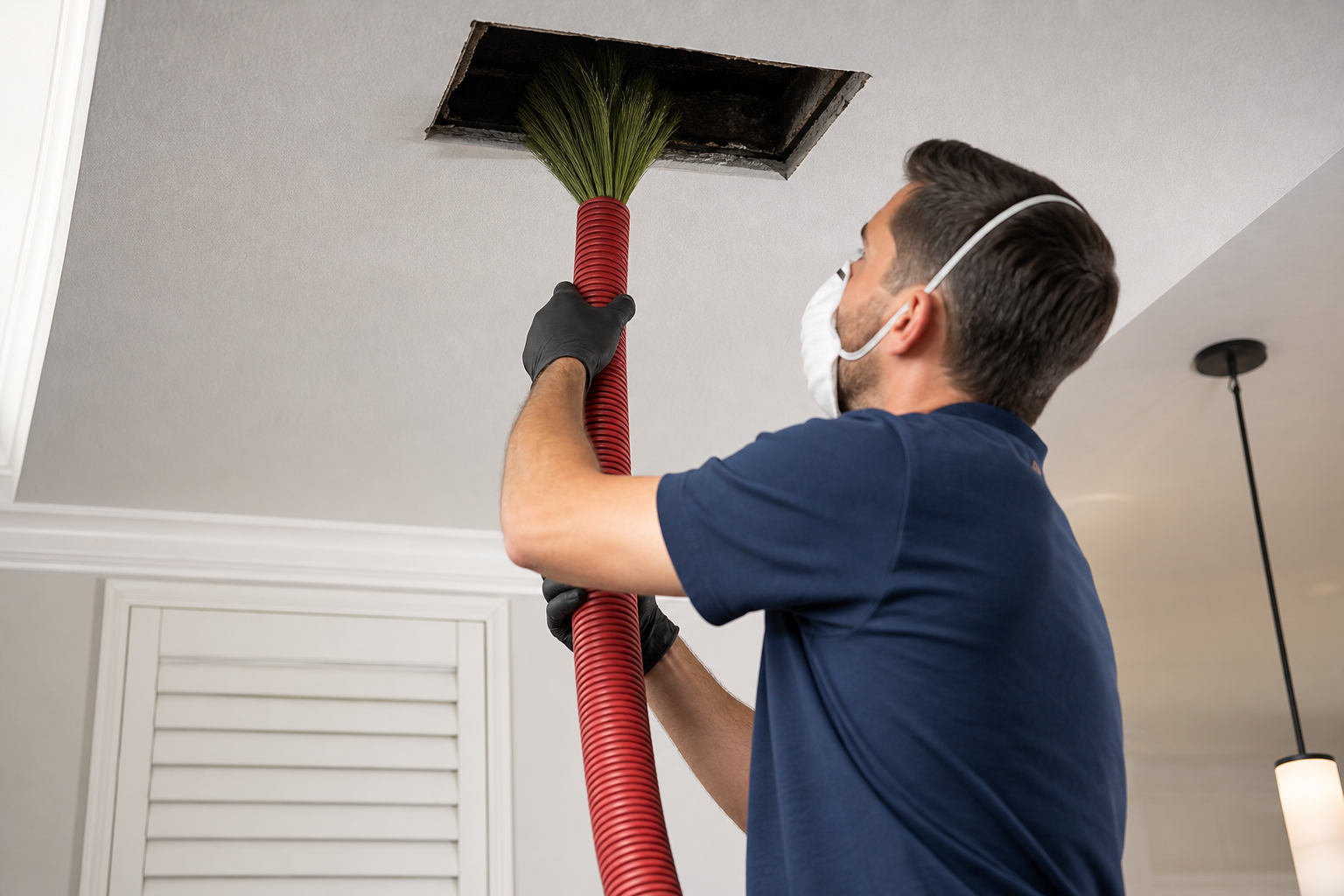
Professional-grade Rotobrush and Nikro systems, not shop-vac shortcuts — that’s the standard we hold ourselves to. 17 years. One specialty. Clean air.
When to Call a Pro in Nashville
If you’ve had renovation work done, notice uneven heating or cooling between rooms, see visible dust at supply registers, or your HVAC filter loads faster than manufacturer recommendations, your ductwork likely needs professional attention. Post-construction cleaning is particularly critical in Nashville’s booming neighborhoods — we’ve found drywall compound, insulation fragments, and even discarded lunch wrappers in new-build ducts.
Related services in Nashville: Air Duct Cleaning in Nashville, Dryer Vent Cleaning in Nashville, and HVAC Cleaning in Nashville.
The Bottom Line
Nikro equipment represents genuine professional capability — but only in hands that understand negative pressure physics, Nashville’s varied housing stock, and the verification steps that prove a job was done right. The brand on the truck matters far less than the technician’s process. From duct cleaning to duct repair to air quality sanitizing — handled start to finish — we believe homeowners deserve both capable equipment and operators who know how to use it.
If you’re in Nashville and want to discuss whether your system would benefit from a properly executed Nikro-based cleaning, Horizon Air Duct Cleaning Nashville offers free estimates. Call (844) 839-1347 and ask for David — we’ll review your system layout, explain what proper containment looks like for your home, and give you upfront pricing with no pressure.
Frequently Asked Questions
Professional duct cleaning with negative-air equipment in Nashville typically ranges from $400 to $800 for a standard residential system, with larger homes or heavy contamination pushing toward $1,000-$1,400. The variation depends on system size, accessibility, and whether dryer vents or HVAC components are included. Call (844) 839-1347 for an exact quote — estimates are free.
They’re different tools for different situations. Nikro excels at high-contamination jobs requiring contained negative-air removal, while Rotobrush systems with contact cleaning are effective for routine maintenance and lighter buildup. We use both — Nikro for heavy restoration work and post-construction cleanup, Rotobrush for standard residential maintenance where brush contact and vacuum extraction suffice. The right choice depends on your duct condition, which we assess during our free estimate.
A thorough cleaning with full containment verification takes 3 to 5 hours for a typical Nashville home, not the 45-minute “blow-and-go” jobs some companies advertise. The setup, testing, and verification sequence alone takes 45-60 minutes before agitation begins. If a company quotes under two hours for a complete system, they’re skipping steps that matter.
Yes, when containment is properly maintained. The negative pressure should keep all debris inside the ductwork and vacuum system. We do recommend that allergy-sensitive individuals, infants, and elderly residents step out during the agitation phase as a precaution — even with proper containment, some transient dust can occur when access panels are opened. We coordinate timing with Nashville families to minimize disruption.
Written by David Martinez, Owner & Lead Technician at Horizon Air Duct Cleaning Nashville, serving Nashville since 2009.
Need Air Duct Cleaning Help?
Call Horizon Air Duct Cleaning Nashville — licensed & insured, here with fast after-hours help in Nashville.
(844) 839-1347