
How Often Should You Clean Your Air Ducts in Nashville, TN? The Real Interval Is Condition-Based, Not Calendar-Based
Most Nashville homes need air duct cleaning every 3 to 5 years as a baseline, but that national average falls apart fast here. If your home has original 1960s ductwork in Donelson, sits downwind of a construction site in The Nations, or your family tracks cedar pollen symptoms through winter, you’re looking at a completely different timeline. Call Horizon Air Duct Cleaning Nashville at (844) 839-1347 and we’ll show you exactly what’s inside your system before you decide anything.

We’ve been cleaning ducts across Nashville for 17 years, and the calendar method is the first thing we ask homeowners to forget. David Martinez, our owner and lead technician, grew up in Donelson not far from the old Opryland grounds. He picked up his HVAC fundamentals at Nashville State Community College and shifted entirely to Air Duct Cleaning services after seeing how many contractors were running shop vacs through registers and calling it done. What matters isn’t the date on your calendar — it’s what’s actually accumulating in your ductwork, and Nashville’s combination of basin-trapped pollen, brutal humidity, and two very different housing stocks creates conditions that can overload a standard 3-to-5-year interval before you hit year two.
Why the Generic 3-to-5-Year Rule Fails in Nashville
The standard recommendation assumes moderate pollen, average humidity, and relatively modern ductwork in decent repair. Nashville satisfies none of these assumptions reliably.
Our city sits in a geographic basin ringed by cedar and hardwood forests. The Asthma and Allergy Foundation of America consistently ranks Nashville among its “Allergy Capitals,” and that pollen load doesn’t behave like it does in flatter, drier cities. Eastern Red Cedar pollinates from December through March — a winter allergy window that catches most homeowners off guard. Your HVAC system is pulling heavy pollen loads during heating season, not just spring, and that winter pollen layer gets compounded by summer humidity into a paste that standard intervals don’t account for.
Then there’s the humidity itself. From June through September, Nashville routinely hits 90°F-plus with sustained 70%+ relative humidity. HVAC systems run nearly continuously, and return-air ducts pulling moisture-laden air all summer are consistently the site of biological growth that would dry out faster in a climate like Dallas or Denver. We’ve opened systems in August where the first foot of return duct looked like a petri dish — not because the homeowner neglected anything, but because the conditions here accelerate what a national average timeline can’t predict.
The construction boom adds another variable. A significant share of Nashville residents live within a quarter mile of active building sites. Silica dust, drywall particulate, and wood dust load ductwork faster than normal residential accumulation. If you’re in Germantown, 12 South, or The Nations and there’s been a crane visible from your porch since 2018, your interval is shorter. Full stop.
David’s Two-Minute Check: Has Your Interval Already Passed?
After 17 years of opening duct systems across Nashville, David Martinez tells customers to look at exactly two things before worrying about calendar years:
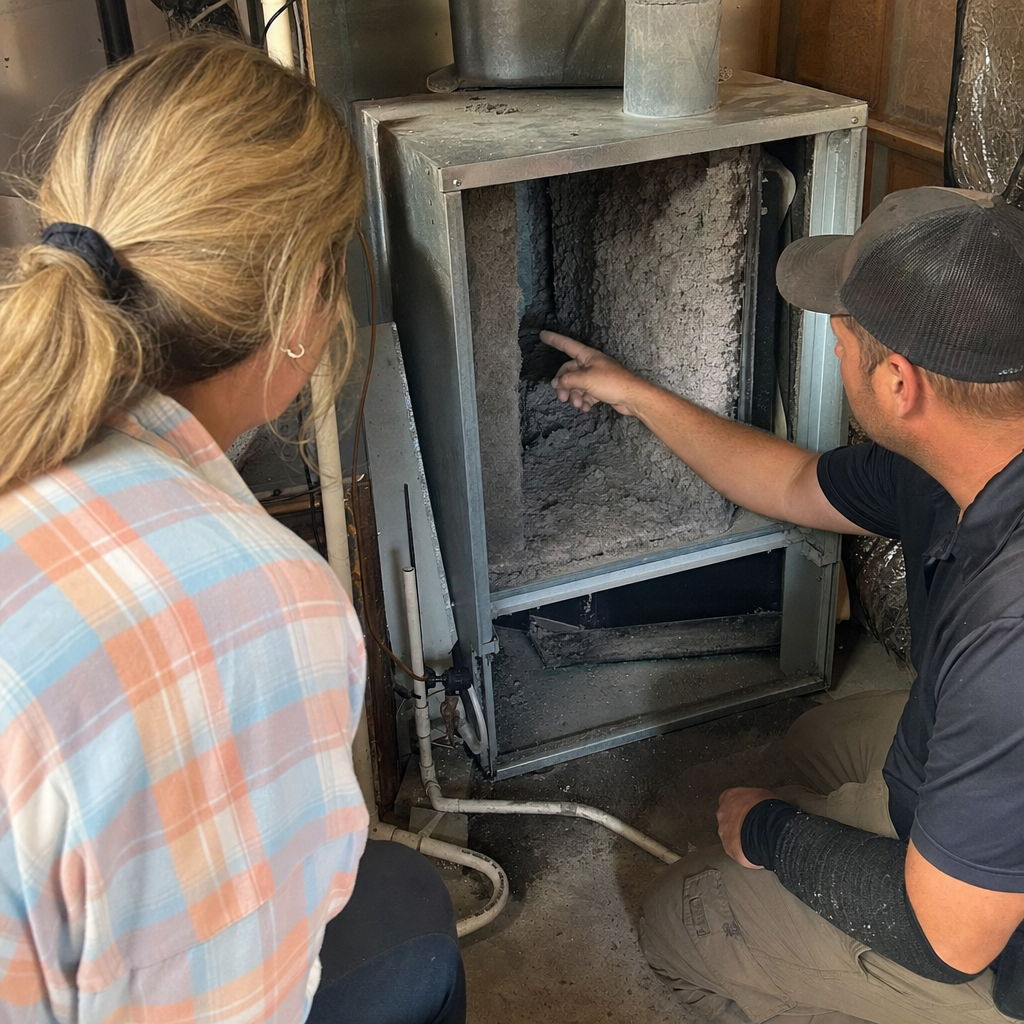
- The return grille: Pop it off and look at the back side. If you see a gray-to-black mat of dust and debris, or if the grille fins are clogged, your system is already recycling that material through every room.
- The first foot inside a supply register: Shine a flashlight down the duct. Visible debris, discoloration, or any sign of moisture staining means the interval has passed regardless of what the calendar says.
Clean ducts aren’t glamorous. Neither is good plumbing. Both matter. If either check shows buildup, the 3-to-5-year rule was already too conservative for your conditions.
Five Nashville-Specific Triggers That Override Any Calendar
These conditions should prompt cleaning regardless of elapsed time. We’ve encountered every one of them repeatedly across Nashville’s neighborhoods, and they represent real Information Gain over generic national advice.
Original Ductwork That’s Never Been Cleaned
In Donelson, Madison, Antioch, and Hermitage, we regularly enter ranch-era homes with flexible or early sheet-metal ductwork installed in the 1960s or 1970s. These systems have sagged, separated at joints, or corroded — and they’ve never been professionally cleaned. The starting baseline isn’t “3-5 years ago.” It’s 20 to 50 years of compacted debris, including layers of older insulation breakdown, construction residue from original build-out, and decades of accumulated pollen loads specific to Nashville’s basin geography. If your home fits this profile, the interval conversation is moot. You’re starting from a restoration baseline, not maintenance.
Documented Mold History or Musty Cycling
Nashville’s humidity makes condensation-driven mold and biofilm inside duct systems a common finding, not an edge case. If your system has ever had visible mold, or if you smell mustiness when the AC cycles on, cleaning isn’t preventive — it’s corrective and urgent. We’ve pulled systems where the evaporator coil drip pan had been leaking into the return plenum for two seasons, creating a layer of microbial growth that no filter could stop. The interval in these cases is “now,” not “maybe next year.”
Post-Renovation Dust Loading
This is one of the most underaddressed triggers we see. Even well-contained renovations generate drywall dust, silica particulate, and insulation fragments that find their way into returns. The “tall-and-skinny” spec townhomes built since 2012 in The Nations, East Nashville, and 12 South are especially vulnerable because their ductwork runs through tight vertical chases across three floors. Construction dust from any floor can migrate through the entire system. We cleaned a system in 12 South six months after a kitchen renovation where the homeowner had run HEPA purifiers constantly — and we still extracted nearly four pounds of fine particulate from the return trunk alone.
Occupants with Documented Allergy or Respiratory Diagnoses
David got serious about indoor air quality when his daughter was young and struggling with persistent allergy issues. Cleaning their own system was the first intervention that made a real difference, and that personal experience shaped how Horizon approaches homes with sensitive occupants. If someone in your household has asthma, allergic rhinitis, or other respiratory conditions, the standard interval doesn’t apply. You’re managing air quality as a health variable, not a maintenance schedule. In Nashville specifically, the extended cedar pollen season means winter heating months can be as problematic as spring for sensitive individuals — your ducts are collecting allergens when most national advice assumes systems are relatively dormant.
Proximity to Active Construction or High-Traffic Corridors
The basin geography that defines Nashville’s topography traps airborne particulates at ground level. If you live near I-440, I-65, or any of the corridors where commercial and residential construction has been continuous since 2015, your ducts are loading faster. We see this clearly in areas like Germantown and the edges of downtown, where infill construction creates a sustained dust environment that suburban homes in established neighborhoods don’t face. The interval shortens proportionally.
How Nashville’s Two Housing Types Need Different Approaches
Nashville’s housing stock splits into two distinct categories, and the cleaning interval and method differ meaningfully between them.
The 1950s–1970s ranch homes in Donelson, Madison, Antioch, and Hermitage typically have accessible crawlspace or attic duct runs. Our Rotobrush and Nikro systems — professional-grade negative-air and contact-cleaning equipment, not shop-vac shortcuts — can navigate these layouts efficiently. But the age of these systems means we often find disconnected joints, corroded fittings, or collapsed flexible sections that need repair before cleaning is even worthwhile. The interval here is often “inspect first, then decide” because the ductwork itself may need restoration.
The “tall-and-skinny” infill townhomes present a completely different challenge. Supply runs squeezed through 3-story vertical chases with sharp 90-degree offsets at each floor transition bind standard rigid cleaning rods. Technicians who trained in low-slung ranch suburbs regularly find themselves underprepared when they take jobs in Germantown or 12 South. We’ve invested in flexible-drive systems and camera-guided equipment specifically for these layouts because the standard approach simply doesn’t reach past the first elbow. If you own one of these properties, your cleaning interval is meaningless if the technician can’t actually access the full duct network.
What Professional Air Duct Cleaning Actually Costs in Nashville
Cost is always part of the interval conversation, and we quote transparently because opaque pricing is how generalist contractors turn duct cleaning into an upsell circus. For a detailed breakdown, see our guide to Whole House Air Duct Cleaning Cost in Nashville, TN. These are real Nashville market ranges based on what we’ve quoted and completed over 17 years:
| Service Scope | Typical Nashville Range |
|---|---|
| Standard residential air duct cleaning (single system, up to 12 vents) | $300 – $500 |
| Larger homes or dual-zone systems (15+ vents, multiple returns) | $450 – $700 |
| Homes with original never-cleaned ductwork requiring restoration cleaning | $500 – $850 |
| “Tall-and-skinny” townhomes with complex vertical chase access | $400 – $650 |
| Dryer vent cleaning (add-on or standalone) | $120 – $200 |
| Duct repair and sealing (per linear foot or section) | $150 – $400 |
| Air quality sanitizing with EPA-registered products | $75 – $150 |
We don’t quote over the phone for complex systems because “12 vents” doesn’t tell us if three are inaccessible or if the return trunk has a foot of compacted debris. What we do promise: David Martinez shows up as the lead technician, runs a camera where needed, and gives you a fixed price before any work starts. No “starting at” numbers that triple on arrival. From duct cleaning to duct repair to air quality sanitizing — handled start to finish.
What Our Process Looks Like When the Interval Has Come
When we clean a system, we use truck-mounted negative-pressure equipment from Rotobrush and Nikro — the same systems industry specialists rely on, not rental vacuums with a brush attachment. The process matters because half-cleaned ducts are arguably worse than untouched ones: you’ve dislodged debris without fully extracting it, and now it’s circulating more aggressively.
Our standard residential job runs 3 to 5 hours depending on system complexity. We seal and pressurize the duct network, agitate debris with mechanical brushes or compressed-air whips, and extract everything to a HEPA-filtered collector. We run before-and-after camera documentation because David believes a customer who understands what’s happening is a customer who trusts the work. For homes with biological growth, we apply sanitizing treatments from trusted product lines — we work with Guardsman and Abatement Technologies among others — but only where indicated, not as a blanket upsell.
When the owner is the technician, accountability isn’t a policy — it’s personal. 17 years. One specialty. Clean air.
FAQs
If someone in your Nashville home has documented allergies or asthma, plan on cleaning every 2 to 3 years rather than the standard 3 to 5, and consider an inspection after any unusually severe pollen season. Nashville’s December-through-March Eastern Red Cedar pollen and heavy summer mold spore loads mean your system is collecting allergens year-round, not just in spring. Call (844) 839-1347 for a free assessment — we’ll show you what’s actually in your returns.
Cleaning is almost always the more Affordable Air Duct Cleaning in Nashville, TN option unless your ductwork is physically deteriorating — sagging flexible duct, corroded metal, or multiple disconnected joints. In Nashville’s ranch-era neighborhoods like Donelson and Hermitage, we often find original ductwork that needs some repair and sealing but is fundamentally sound; replacement runs $3,000 to $7,000+ versus $300 to $850 for thorough cleaning with minor repairs. We’ll tell you honestly if replacement makes more sense — our scope is cleaning and repair, not duct fabrication, so we have no incentive to oversell replacement. Call (844) 839-1347 for an honest evaluation.
Yes — sustained construction activity within a quarter mile can measurably shorten your cleaning interval. Nashville’s basin geography traps silica dust, drywall particulate, and wood dust at ground level, and your return air pulls that material directly into the system. We’ve extracted heavy construction-related loading from homes near active sites in The Nations, Germantown, and 12 South that had been “cleaned” just two years prior by owners who didn’t realize their environment had changed. If you can see active construction from your property, treat 2 years as your new baseline and inspect annually. Call (844) 839-1347 and we’ll assess your specific exposure.
Demand before-and-after documentation, ask what equipment was used, and verify the technician accessed every register and return. A proper job with professional-grade Rotobrush or Nikro systems takes 3 to 5 hours for a standard home — if someone was in and out in 45 minutes with a shop vac and a brush, you got a surface wipe, not a cleaning. At Horizon, David Martinez runs camera footage and shows homeowners the extraction results because 17 years in this trade has taught us that visible proof beats any promise. If you’re unsure about a previous service, call (844) 839-1347 for a verification inspection — estimates are free.
When to Call Horizon Air Duct Cleaning Nashville
If you’ve checked your return grille or shone a flashlight down a supply register and didn’t like what you saw, the calendar doesn’t matter. Whether you’re in a 1968 ranch in Hermitage with original ductwork that’s never been touched, a three-story townhome in 12 South with chases we need specialized equipment to navigate, or anywhere in between — we’ll show you what’s there, explain what it means for your air quality, and give you a fixed quote before any work starts. 501 customers reviewed us. See what they found.
If you’d rather have it looked at, Horizon Air Duct Cleaning Nashville offers a no-pressure assessment in Nashville — call (844) 839-1347. Still deciding? Read Is Air Duct Cleaning Worth It? (Nashville, TN).
Written by David Martinez, Owner & Lead Technician at Horizon Air Duct Cleaning Nashville, serving Nashville, TN.